No maintenance without divers: a team of divers is preparing to carry out maintenance work on the lock at the Freudenau Danube power plant
VERBUND, Austria’s leading provider of sustainable energy, began preparations for this year’s autumn maintenance at the Freudenau Danube power plant at the end of October. The left-hand lock is due for maintenance this year. To enable the lock chamber to be drained, power plant divers clean the floor in front of the lock gates and the areas where the stoplogs are to be installed. To this end, the three-person diving team from Lestin – VERBUND’s diving contractor – is on site, including Regina Karrer, Austria’s only active power station diver.
“No divers, no maintenance,” says VERBUND Project Manager Michael Artmann. “First of all, the riverbed upstream and downstream of the lock must be cleared so that the stoplogs, which weigh several tonnes, can be positioned correctly. A clean contact surface is essential to ensure that they seal properly and that the lock can be drained. To prepare for the stoplogs to be installed, the divers must unhook the individual stoplog sections from the floating crane underwater (four sections on each side, upstream and downstream).”
A well-coordinated team in action
The diving team at the lock consists of three people. While one diver works underwater, a colleague monitors the operation and maintains communication. A third team member assists with the diver’s lifeline and stands by in case of emergency. The divers take turns: at a depth of 13 metres, a dive lasts around an hour, up to a maximum of 80 minutes, after which they swap over.
“The work requires a great deal of experience and a delicate touch,” says Thomas Vondal of Lestin, who is leading the operation. “Our divers inspect, monitor and clean these areas, usually in poor visibility and cold water. To do this, they must be able to rely on their equipment and the support of the team on the surface.”
Working without visibility
For power plant divers, the work is physically demanding and carried out in challenging conditions. At a depth of 13 metres, they remove sand, gravel and timber from the bed of the Danube in front of the lock gates, both upstream and downstream of the power plant. Visibility underwater is often seriously limited.
“On some days, visibility is clear, but most of the time you can barely see 30 centimetres ahead,” says professional diver Regina Karrer. “Then you have to find your way by feel.”
Before the divers began work, a diving robot was lowered to the bottom of the lock to inspect the rail into which the stoplogs are fitted, as well as the floor. “The robot has measured ten centimetres of sludge,” says power plant diver Gerhard Frank as he puts on his diving gear, “and that now needs to be removed.” His diving kit, together with his helmet and vest, weighs around 50 kg. At the bottom of the lock, he works his way along the rail using a magnet and removes the accumulated dirt with a water jet and by hand. A helmet-mounted camera transmits the images to the surface. During the dive, operation leader Vondal remains in contact with him by radio.
Work on the upstream side takes approximately two to three hours, after which the stoplogs can be installed using the floating crane. The divers then work on the downstream side at a depth of six metres. Once the stoplogs are in place, the lock chamber is drained and routine maintenance begins over the winter months. Both navigation locks at the Freudenau run-of-river power plant are serviced every nine years.
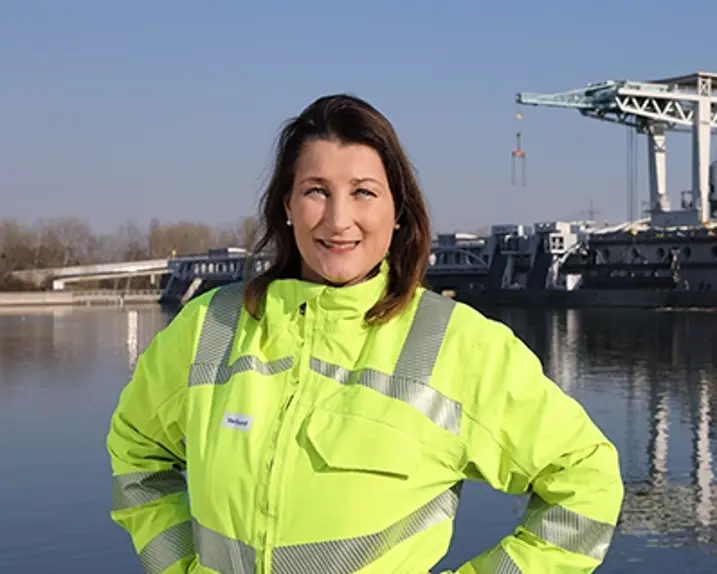
Eveline Fitzinger
Communications Manager